Sakura design line
Japandi: Where Japanese Precision Meets Nordic Ease
Fine frames, warm oak and a velvety white front. nobilia's Sakura line turns the Japandi idea into a planned system, so the calm you see in the photos holds up in a real, working kitchen.

The collection
16 natural & scandi kitchens to start from
Every kitchen below can be re-planned for your room: other dimensions, another worktop, a different handle. Use the filters, then open a kitchen for its full specification.
16 kitchens
 New
Faro oak elegance to the ceiling

White frames with natural wood grain

Taupe grey to the ceiling, oak at the heart

Subtle texture in calm sand

Oak you want to touch

Glossy white with a three-layer counter

Vertical oak grain, calm and grounded

Oak and black glass in balance

Warm macchiato meets light oak

A white you want to touch

Sand matt without the glare

Satin grey and oak for family life

White, bronze and cognac in harmony

Warm oak with a built-in workspace
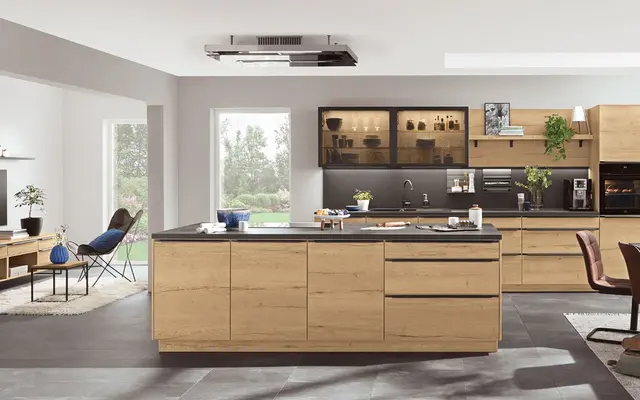
Sierra oak with a dark concrete counter

A food blogger's well-ordered kitchen
No kitchen matches every filter. Clear one to see more.
01 Two traditions
Why Japandi feels so restful
Japandi joins the Japanese love of clear lines and empty space with the Scandinavian taste for light wood and comfort. The result is a room with very few elements, each chosen with care.
For anyone tired of visual clutter, that restraint is the point: fewer finishes, more storage behind closed doors, and surfaces that feel good to the hand.

02 The fine frame
A 16 mm outline that gives the room structure
The signature of Sakura is a slim wood-look frame, about 5/8 in (16 mm) wide, that outlines the cabinetry. Side panels and top shelves built deeper than usual project slightly past the fronts to create it.
That thin border gives a minimalist kitchen just enough rhythm, the way a mat frames a print.

03 Worktop and grip
Slim stone, simple oak
A Slim Line worktop only about 5/8 in (16 mm) thick keeps the profile light and matches the frame. The handle is a plain screw-on bar in Como oak, practical to grip and quietly decorative.
In the reference kitchen, SENSO 488 premium matt white sits on a white carcase with a Como oak-look worktop.

04 Your palette
One concept, any smooth front
The Como oak frame is the constant; the fronts are your choice. Sakura can be planned with every smooth front range, from matt plain colors to wood decors, so the look can lean greener, sandier or darker.
We test those combinations in 3D with your flooring and daylight, whether your home is in Houston or Denver.

05 Beyond the kitchen
Japandi for the bath and living room
Sakura continues into the bathroom with white fronts, warm oak elements and bronze-colored fittings, and can carry the same language into the living area. Planning the whole home with one design line gives every room the same quiet confidence.
Below the text you will find the front colors that combine with the Sakura frame. Pick two or three favorites and we will show them in your room before anything is ordered.

| Reference front | SENSO 488, premium honed white |
|---|---|
| Carcase color | 106 White |
| Worktop | 362 Como oak reproduction (Slim Line about 5/8 in / 16 mm) |
| Handle | 315 Bar handle, Como oak matt |
| Frame width | About 5/8 in (16 mm) |
| Compatible fronts | All smooth front ranges |
Questions
Asked often
Anything else? Call 866-936-6180 or send us your plan.
What is a Japandi kitchen?
It is a kitchen that blends Japanese minimalism with Scandinavian warmth: matt surfaces, light woods, very few accents and a carefully balanced layout.
Which fronts suit a Japandi look?
Calm, matt fronts such as SENSO 488 are ideal. Light oak decors and handleless fronts work well too, and the Sakura frame combines with every smooth front.
Is Japandi practical for everyday cooking?
Yes. The style depends on generous hidden storage, so counters stay clear. SENSO premium matt fronts are also easy to wipe clean.
Can I use Sakura outside the kitchen?
Yes. The line extends to bathrooms and living spaces, so you can plan a consistent Japandi look across your home.
Does a Japandi kitchen need wood floors?
Not necessarily. Light oak floors suit it naturally, but stone, concrete-look or pale tile also work when the cabinetry supplies the wood warmth.
Keep exploring
Related

Japandi design line
Sakura design lineA Japanese style kitchen lives on restraint: fewer lines, honest materials, nothing shouting for attention. Sakura…
Style: Natural/Scandi
Natural & Scandinobilia now calls this direction Natural/Scandi: warm wood grains, pale colors and simple shapes that make a room feel…
The 2026 collection
Collection 2026Sand, macchiato and coffee set the mood for 2026. nobilia paired those soft earth tones with clever new mechanisms, so…Next step
Your kitchen, planned in one conversation.
Bring a floor plan, a photo or just a wish list. We measure, design in 3D, order from Germany and install with our own team in Texas and Colorado.